
If you have not picked your blackberries (ouch, bloody thorns,) at this stage then it’s probably too late. I did my usual picking last week and managed 1.5 Kilos in a spot that I visit annually. To that we have added the apples from our trees in the garden and a few plumbs. So we have the Wild Blackberry, Garden Apple and Sweet plum jam ready for distribution in 12 weeks time.
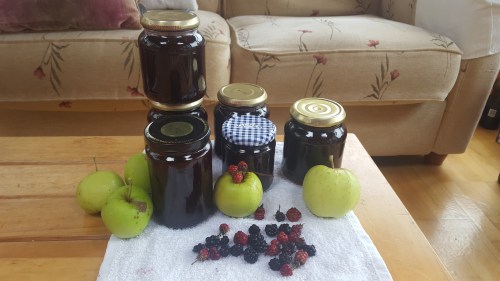
Folklore has it that Blackberries should be picked before Michaelmas which falls on Saturday 29th. September, as the devil has made them unfit to eat by stepping, spitting or fouling on them. There is some value in this legend as autumn’s wetter and cooler weather often allows the fruit to become infected by various moulds, but these are pretty obvious and for sure no bad ‘uns made it into the Carrigaline Batch.
Michaelmas
The name Michaelmas comes from a shortening of “Michael’s Mass,” in the same style as Christmas (Christ’s Mass) and Candlemas (Candle Mass, the Mass where traditional candles used throughout the year would be blessed).
Also known as the Feast of the Archangels, and the Archangel Michael is the seen as the greatest of all the Archangels and is honoured for defeating Satan in the war in heaven (Hence the Devil’s mischief at Michaelmas)
In the fifth century a basilica near Rome was dedicated in honour of Michael on 30th. September, beginning with celebrations on the eve of that day, and 29 September is now kept in honour of Michael and all Angels.
Because it falls near the equinox, it is associated in the northern hemisphere with the beginning of autumn and the shortening of days.
According to some Christian traditions, a blackberry’s deep purple color represents Christ’s blood and the crown of thorns was made of brambles, although other thorny plants, such as hawthorn and crown of thorns plant have been proposed as the material for the crown.
Foraging
Blackberries are one of our ancient fruits as they were eaten by early settlers. They are high in Vitamin C and were also picked by those who knew the scourge of scurvy. They also pack a punch of potassium and Vitamin E and of course the wild ones have the highest concentration. There is an old rule observed by foragers, pick only a third from the bramble bush that you find, leaving a third for the wildlife and one third for the plant to regenerate.


 findmywhy